
Vesta oven user manual
The VESTA charcoal oven is an CLOSED GRILL controlled by an adjustable draft system: first from below - when air enters, then from above - at the exit of smoke. The front of the oven is equipped with a convenient hinged door. Charcoal burns inside, over which grates and roasting trays are placed.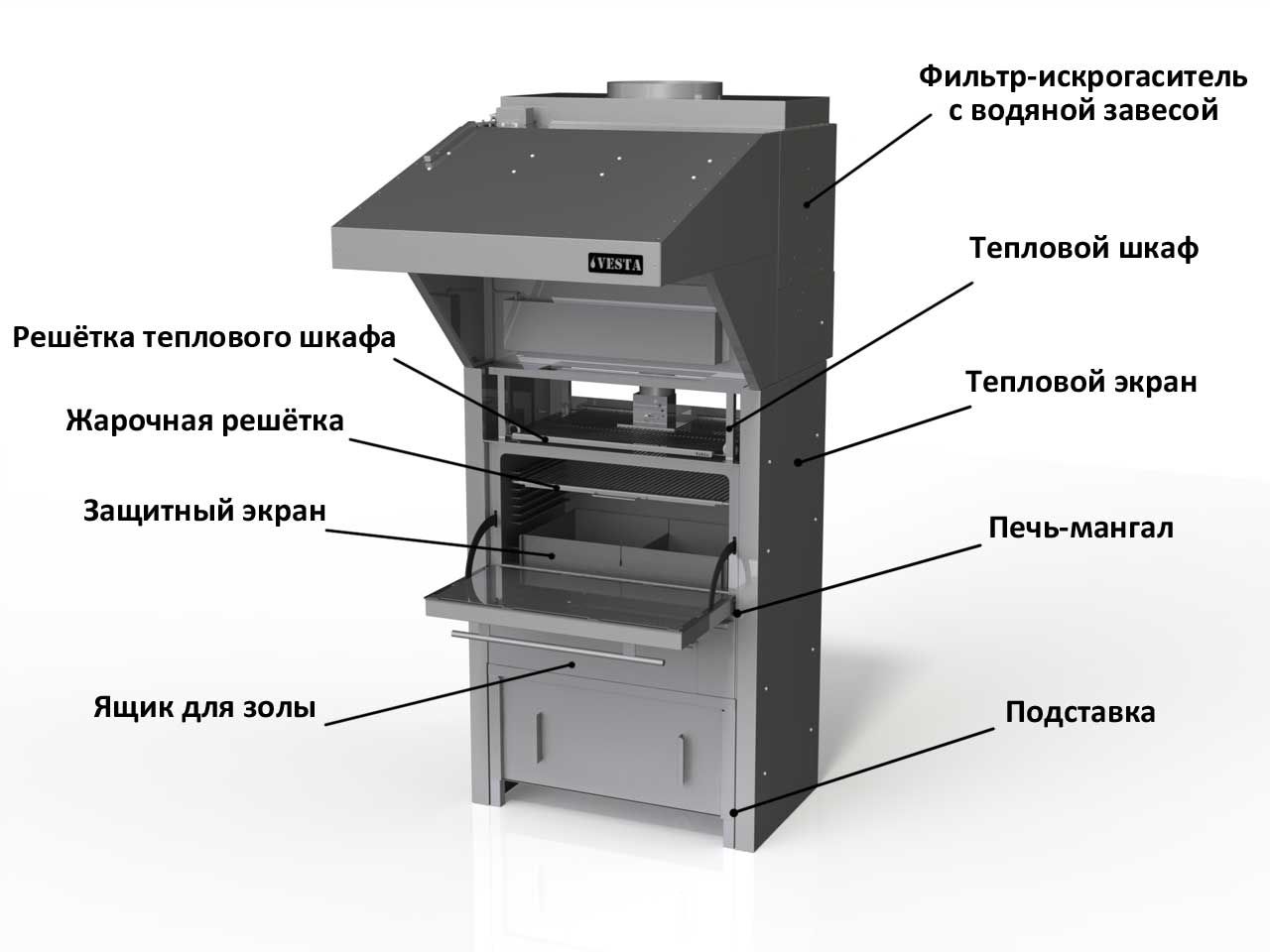
Before first use
Without loading food into the chamber, bake the equipment for 60 minutes. Protective grease remaining on metal parts should burn off.
Coal loading
- Remove the rack from the grill chamber.
- Put coal to the grille for coal. Leave a gap of 10-15 cm free from coal along the back wall of the brazier for unhindered air access. Coal will grow faster if it is rolled down.
The amount of coal loaded depends on the quality of the coal. Worse coal - less heat - more coal must be loaded. We recommend starting with a load of 3 - 5 kg and then choose the most convenient load for you experimentally.
Coal ignition
Open the chimney damper and blower hole. The flue damper is located at the top of the grill. To open it, you should set the lever-handle in a vertical position. The blower hole is located at the bottom of the grill. Opening - closing is controlled visually. Pull out the ash drawer about 5 cm. Light the charcoal with a match or lighter in three places: at the top of the mound and on both sides at the bottom. Do not push the ash drawer all the way in, leave a small gap. This improves air circulation and speeds up the process of coal ignition.
ATTENTION! It is strongly not recommended to light the grill with charcoal starter liquids!
- The specific smell of burning petrochemical products will fill your kitchen.
- People with a delicate sense of smell can smell this smell in products cooked on the grill and many hours after using the liquid.
To ignite charcoal in a professional grill, you can use dry alcohol tablets. They burn with an almost colorless flame, and most importantly, they have no smell.
Before loading food into the chamber
- Close up pissed. Slit box for ash to the end, not leaving the gaps.
- Open the chamber door and check the condition of the charcoal.
- Using a poker, level the charcoal and evenly distribute it over the grate.
- Insert the pole grid into the device. The height of the grids above the layer depends on the type of product, pre-designated for thermal processing.
- To cook meat, the grate should be set to the lower position, above the layer of coal.
- For grilling fish and vegetables, the grate must be raised higher.
- Close the chimney damper. To do this, you need to turn the flap lever into a horizontal position. Make sure the hole has pissed too closed.
- Close the camera door and wait 5-10 minutes, and then open the chimney flap for the release of combustion products from the grill chamber.
- Open the chamber door and check that there is no flame.
- Partially open the chimney damper. The grill is ready for cooking.
Cooking food
- During the entire cooking process, the chimney damper must be slightly open and the blower must be closed.
- If during operation (for example, when cooking a large amount of food at the same time), smoke begins to come out of the gap between the door and the grill body, it is necessary to open the chimney damper as much as necessary to completely evacuate the combustion products.
At the end of the cooking process, it is necessary to close the chimney damper.
Increasing the oven temperature
If during operation it became necessary to raise the temperature in the furnace, for example, from 150 to 200 degrees. C Open the top and bottom shutters to 'full power'. Close the dampers when the set temperature is reached. The oven will go into standby mode.
Reducing the oven temperature
When igniting coal, the stove can be 'overheated' to 300-400 degrees. C. And the meat is fried at a temperature of 200-250 degrees. C. There is not always time to wait for the stove to cool down naturally by closing the blower and the chimney damper. In practice, two methods are used to bring down the temperature of coal:
- Spray with water. It is very convenient to use a manual sprayer.
- Sprinkle the coals with coarse salt.
Which one will be the best and most convenient for you is up to you to decide.
NOTE: Sometimes we come across the statement that Spanish ovens cook food at a temperature of 400-500 degrees. Please pay attention to the scale of the thermometer. Asian thermometer manufacturers make them for both the European and American markets. Accordingly, there are two scales on the thermometer: the upper one is in degrees Fahrenheit and the lower one is in degrees Celsius. s
Table of grill dampers positions
| Mode | Bottom damper | Upper damper |
| Ignition | open | open |
| Cooking | closed | closed 30-45 degrees |
| Waiting | closed | closed 90 degrees |
| Raising temperature | opened | opened |
| Shutdown | closed | closed 90 degrees |
Cooking Tips
The most convenient and universal temperature in the furnace was 150 degrees C according to the thermometer on the door, while inside the oven it was 170-190 degrees. At this temperature, meat, fish, chicken are perfectly baked. On steaks, you can get a given degree of roasting (5 degrees). At higher temperatures, cooking is too fast and food can be easily overcooked.
Examples:
- Meat - beef tenderloin, minion 150 g. 4 cm high. The temperature on the thermometer is 150 degrees. A grate and a cast-iron plate 300x300 mm laid on it were used. (cast iron grill).
- Medium:Burning meat on a cast-iron grill (closing the pores) 20 + 20 sec. Meat on the wire rack 2 + 2 min. Tinting on cast iron grill 30 + 30 sec. Total cooking time - 5.5 minutes./li>
- Medium well: Burn 20 + 20 sec. Meat on the wire rack 2 +2 min. Rest. Meat on the wire rack 1 +1 min. Grilled tinting 1 min. Total cooking time - 7.5 minutes.
- Well done: Meat on the wire rack 3 +3 min. Cast iron grill 1 min. Total cooking time - 7 min.
- Fish: Salmon 200 g. 2 cm thick. On a wire rack 4 min.
The steaks are tender, with a lot of juice inside, with a beautiful brown crust and a grill pattern.